
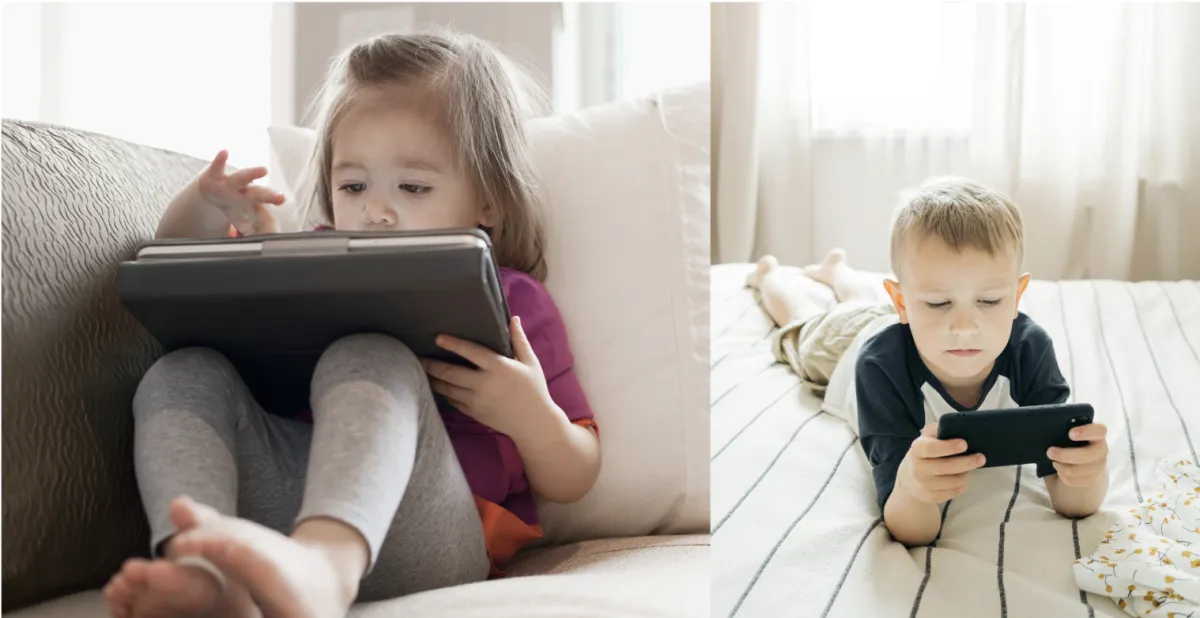
Less Screen Time, But Then What?
If I’m honest, this is not an easy article to write as a parent who’s had many battles over screen time with my own children. So the last thing I want is for this to sound like I’m preaching from a place of having got this right, because we didn’t! And I regret that. 😔
Our children are now young adults, but they were part of that cohort whose parents didn’t really know what had hit them. Over a decade ago, many of us hesitantly handed out smartphones and iPads with little knowledge or guidance about whether we should.
But this article isn’t about our family.
It’s about what the research is telling us now, and what that means for parents raising young children in a world saturated by screens📱. Because the reality is that screens seem to be woven into modern family life these days, and when parents are tired 😩, stretched, and juggling a million things, offering your child some screen time can feel like a lifeline.
And yet, many parents feel deeply conflicted.
On the one hand, they’re hearing about the potential harms of too much screen time in childhood ⚠️. On the other, screens offer immediate relief and, let’s be honest, often what looks like heaps of fun for kids.
But there comes a point where we have to face what the evidence is telling us, even when it’s uncomfortable and seems to involve difficult changes.
So, what is the evidence on screen time in childhood…? 😬
You’ve likely heard some of this already, but it’s worth laying it out.
It’s become clear that ‘excessive’ screen use in childhood is linked to increased anxiety, loneliness, sleep disruption, and reduced face-to-face interaction. These, in turn, are associated with a range of developmental delays.
GP and wellbeing expert Dr Rangan Chatterjee has described this shift as “the most urgent public health issue of our time,” (1) and while that may sound dramatic, the research all seems to point in the same direction. In early childhood especially, high levels of screen exposure are linked to poorer attention, delays in language and social development, and an increased risk of mental and emotional health challenges in later childhood and adolescence.
And if you’re thinking this is perhaps just a fringe concern, you may want to think again. Recent Australian data (2) suggests that around 83% of preschoolers and 85% of primary school-aged children exceed recommended screen time limits.
Psychologist Jonathan Haidt has helped bring this issue into sharper focus through his research, his tireless campaigning, and his bestselling book The Anxious Generation (3), detailing the ways in which childhood has shifted over the last 2 decades from a play-based, socially rich experience to one that’s increasingly mediated by screens. 💻
Haidt recognised early on that parents are crying out for practical guidance and clear norms around technology use. So we’ve taken the hard work out of this for you (you're welcome! 😇) and created our Screen Time Guidelines for Parents of Children 0-8 years. [Our guidelines are based on Haidt and other experts' recommendations as well as those from various research and childhood wellbeing organisations.]
In our screen time guidelines document you'll find details on recommended screen exposure limits for young children, as well as a range of helpful recommendations and tips for managing screen usage in early childhood (download the guidelines here).
Now, it’s important to say: we are focusing here on early childhood (roughly ages 0–8).
The role of digital technology in later childhood and adolescence is far more complex. For some young people, particularly those who are neurodivergent or socially isolated, online spaces can offer a sense of meaningful connection, identity, and belonging.
But for most young children, the evidence points in a clear direction: too much screen time is associated with significantly poorer developmental outcomes.
But… what fills the gap when screen time is reduced? 🤔
This is a question that many conversations about screens in childhood overlooks.
And yet it’s crucial, because children don’t automatically thrive just because a device is taken away or their overall screen time is reduced.
In fact, in the short term, it can look like the opposite is happening!
Children can become suddenly upset, agitated, even angry and aggressive 😡. But these kinds of reactions should be expected if Dr. Anna Lembke is right in her book Dopamine Nation (4), when she explains that children are simply exhibiting the withdrawal effects from dopamine-inducing screen time. So, it’s understandable that many parents give in and extend screen time, not because they don’t care, but because the alternative feels so challenging in the moment.
Yet the bigger question remains: What fills the gap created by reduced screen time?
Well, the first thing you’re likely to see in your child is a healthy dose of boredom! 😐 Research has shown though that periods of boredom in early childhood are linked to more creative thinking and imaginative play 🎨, improved coping strategies and a sense of autonomy 💪, an increased likelihood to seek social interactions 🤝 and to initiate play involving others, and so on (5). So, the first thing to do is… embrace signs of boredom in your child!
Crucially, reduced screen time in childhood also creates opportunities for your child to connect with others and in doing so to develop the kind of language, empathy ❤️, social and moral skills and sensibilities that we know are foundational to children learning how to be with others, how to understand others, and how to care about others.
It’s in such moments that children learn how to:
➡️ read social cues 👀
➡️ negotiate and take turns 🔄
➡️ understand another person’s perspective 🧠
➡️ balance their own needs with those of others ⚖️
➡️ and experience how good it feels to contribute and feel needed 🌟
These life skills are built slowly, through interaction, frustration, awareness, and connection.
So, if you’re wondering what can fill the gap, it might look something like this:
• Cooking with an adult 🍳: measuring, mixing, chatting, laughing, learning new words,
• Helping in the garden 🌱: digging, watering, sharing a funny memory,
• Playing with a sibling or playmate 🤗: negotiating rules, taking turns, figuring things out,
• Experiencing boredom 😐: before building a cubby house, a shop, or a fortress,
• Joining in with real family tasks 🏠: setting the table, folding laundry, feeling valued,
• Just lying on the floor or staring out the window 🌤️… until a new idea slowly appears.
The Takeaway 🌼
If you only took one idea from this article it should be this one:
A healthy childhood isn’t just about limiting the time your child spends on screens…
It’s about making space for boredom 😌, imagination 🎨, and most importantly, rich, screen-free opportunities for children to connect with others 🤝 and to discover the positive and nourishing ways they can matter in their world and in the lives of the people around them. 🌟
1.Dr Rangan Chatterjee in The Guardian. https://www.theguardian.com/lifeandstyle/2026/feb/16/dr-rangan-chatterjee-interview-screen-time-mental-health-banning-social-media-18-podcaster
2.Screen time habits of children in Australia. https://www.schn.health.nsw.gov.au/kids-health-hub/screen-time/recommended-screen-time-australian-children
3.Jonathan Haidt, The Anxious Generation. https://www.anxiousgeneration.com/book
4.Dr. Anna Lembke, Dopamine Nation. https://www.amazon.com.au/Dopamine-Nation-Finding-Balance-Indulgence/dp/152474672X
5.The benefits of boredom in childhood:
i) The Role of Boredom in fostering Creativity in early childhood education. https://ritzherald.com/the-role-of-boredom-in-fostering-creativity-in-early-childhood-education-introduction/
ii) The importance of boredom for children’s development in fostering creativity and autonomy https://www.meqbem.com/en/limportanza-della-noia-nella-crescita-dei-bambini-per-stimolare-la-creativita-e-lautonomia/
iii) The association between boredom and creativity. https://bera-journals.onlinelibrary.wiley.com/doi/10.1002/rev3.3470
